

Use Summer 2026 to Explore Whether Panama Is Right for Your Family
Moving to a new country doesn’t happen in one trip. At least, it shouldn’t.



When our family started seriously considering Panama, I approached it the same way I approach complex travel planning for my clients: phased, intentional, and with clear research goals at every stage.
The first visit answered one question — could we see ourselves here?
Subsequent trips went deeper.
By the time we were staying in a long-term hotel with kitchenette in our room, checking grocery stores and commute times, the decision wasn’t emotional anymore.
It was informed.
That process took time, and we’re glad it did.
Which is why I keep thinking about summer 2026 as such a good window for families who are Panama-curious right now. I'm talking about the North American summer — June, July, August — when US and Canadian kids are typically out of school and families have the flexibility to actually go.
You have lead time — real lead time — and that changes everything.
What you can do from now:
Start learning Spanish, or brush up on what you already have. Even basic conversational Spanish will make your trip more meaningful and your interactions more genuine.
Research neighborhoods. Panama City has distinct areas that attract new immigrants — El Cangrejo, San Francisco, Obarrio, Costa del Este, Clayton and Albrook, Panama Pacifico, Costa Verde — and they each have a different feel. Knowing which ones interest you before you land means you’re walking into neighborhoods with intention, not just touring.
Request school tours in advance. International and bilingual schools in Panama are accustomed to prospective families, but admissions teams have calendars too. Getting on the schedule early matters for your scouting timeline.
Connect with a real estate agent and immigration attorney before you go. Your time on the ground is limited and valuable. Having those meetings pre-scheduled means you’re not spending the trip chasing appointments. You may even be able to bring necessary paperwork with you — if you decide to start the residency process before you depart.
I also work with families to design the logistics of these trips so that when you’re here, you can actually focus on the bigger question — whether Panama is the right fit for your family.
Wondering what your kids would actually do during a multi-week Panama scouting trip? There are more options than you'd think.
A few practical things that make Panama easier than people expect:
Panama is dollarized. The official currency is the US dollar (locally called the Balboa), so there are no conversions to calculate and no foreign transaction fees eating into your budget. What you plan is what you spend.
Uber works well in Panama City and is genuinely convenient. For the city portion of your trip, you likely won’t need a car at all. I’d recommend renting one only when you head to the beach communities or the interior — both worth including in a longer scouting trip.
Book accommodations with kitchen facilities. Whether that’s a serviced apartment, an extended-stay hotel, or a villa rental, having a kitchen lets you shop local markets and supermarkets, which is actually a meaningful part of the research. You want to know what groceries cost and what’s available. Eating every meal out doesn’t tell you that.
Things You Might Want to Know about Grocery Shopping here in Panama

Yes, of course you can shop the fresh local market.
What the trip itself looks like:
Depending on how deep you want to go, a family scouting trip can be structured three ways.
7 nights is enough to fall in or out of love with Panama City and get a taste of beach life in an area like Coronado. You’ll meet with an immigration attorney, discover neighborhoods, and come home with a gut feeling plus real data points.
10 nights adds Boquete — the highland mountain town with what locals call “eternal spring” weather and very popular with new arrivals. If Panama City feels too urban or Coronado too resort-like, Boquete often surprises people. David, the provincial capital nearby, gives you a sense of regional infrastructure.
21 nights is the full research immersion. Your kids enroll in a summer camp program (✅ send me an email for the full camp list!) — whether that’s a Spanish immersion camp, an international school program, or a sports camp. You work remotely from a local cafe or co-working space in your top-choice neighborhood. You get a dentist cleaning or medical checkup to trial the phenomenal private healthcare system.
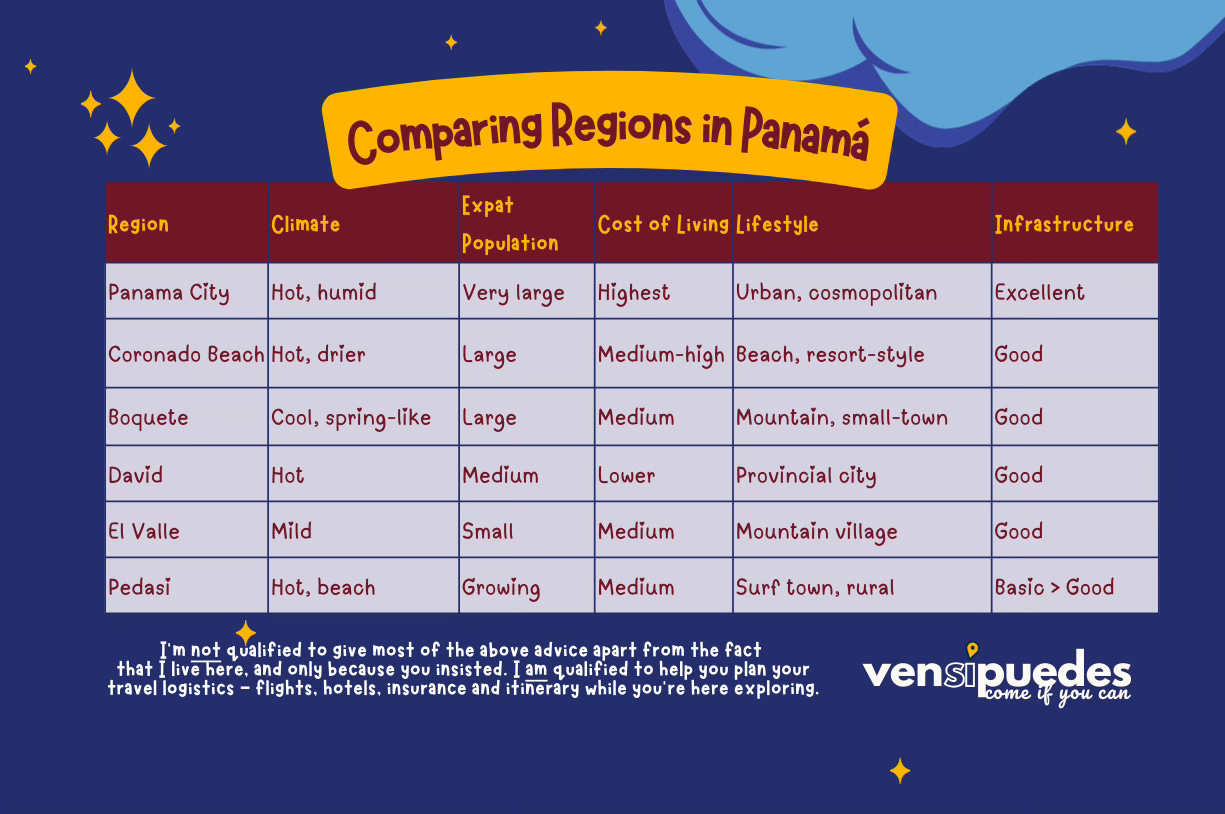
Depending on your family’s lifestyle priorities, we might also build in time to explore El Valle de Antón — a mountain village with a mild climate about two hours from the city — or Pedasí, a growing surf town on the Azuero Peninsula. The comparison chart below is a good starting point for thinking through which regions are worth your time.
All three versions start with the same homework before you leave: a life audit.
Document your family’s typical week at home — school runs, special needs, medical appointments, extracurriculars, religious community, how you like to spend weekends. That schedule becomes your base checklist in Panama.
Remember you’re not here just for sightseeing.
You’re also here to observe and evaluate whether the Panama you hear about on social media and Youtube videos is the Panama that could be your family’s next home.
Those June-July-August months do overlap the rainy season in Panama, but don’t let that put you off. Rain typically comes in the afternoons. Mornings are usually clear, and the landscape is lush and green. It’s also quieter than peak season, which is actually a better environment for the kind of focused research you’re trying to do.
How I Can Help You Plan This:
Here’s my honest position: I’m not qualified to give you immigration, tax, or legal advice — but I live (most of the year) here, and that counts for something.
What I am qualified to do is help you design the right Panama travel experience for your family:
For some, that looks like a fully custom trip — thoughtfully planned around your specific questions, priorities, and pace. As an independent travel advisor, this is exactly what I do to take trip planning off your already-busy plate.
Whether you do the work to plan it yourself or hire me to curate the experience, the goal is the same: helping your family move beyond a surface-level visit and into something that feels informed, grounded, and real.
I’ve also put together several Panama resources you might find useful as you start your research, including A Local’s Guide to Fine Dining in Panama City and The Ultimate Panama City Kosher Travel Guide. And the archive here at VenSíPuedes is full of the kind of rich conversations and practical information I wish we’d had when we were figuring this out ourselves Real Talk Panama | Expat Life - with more thoughtful and helpful content on the way.
You’ve probably looked at the group relocation tours that exist, and they can be a useful starting point. But most of them are built for empty-nesters or retirees — people who are done (DONE!!) working, done with schedules that revolve around the needs of others, and making decisions primarily around cost of living.
If you’re still in your earning years, managing a career remotely or running a business, and navigating the needs of toddlers who need childcare, a regular pediatrician, maybe therapies like speech or occupation therapy, children who skateboard or gymnastics and also need to see the orthodontist monthly, or teenagers who have rigorous academics and college preparation — those tours aren’t really designed with you in mind.
With a custom scouting trip designed specifically for your family, you can all see and experience everything that Panama has to offer both as a visitor and a future resident.
Beyond the relocation research piece, I can layer in everything else that makes Panama worth exploring. I have access to exceptional tours and guided experiences — Miraflores Locks visits, day trips to stunning beaches near Colón, and excursions to the San Blas islands. And, of course, I can coordinate your hotel or extended-stay bookings, airport transfers, and travel insurance so the logistics run smoothly and you can stay focused on the bigger picture and goal.
If your family is seriously considering Panama — or even just starting to ask the question — reach out and let’s talk through what a summer 2026 scouting trip could look like for you. PLUS I’ll send you my curated list of summer camp programs available to visiting families, along with next steps for getting your research trip on the calendar.
✅ Send me a note at makini.bridgewater@fora.travel
This post is free, but if you enjoyed it and would like to support our writing, please do:
💛 Like our post
📝 Reply with a comment
🔁 Restack this post (+ add a note!)
🎟️ Become a paid subscriber
And your support helps more readers considering this journey discover our experience.
xo Ven Sí Puedes | Come If You Can and Real Talk Panama | Expat Life